

Every fall, thousands of students arrive at Montana State University ready for classes, Bobcat game days, and nights out on Main Street. Many of them are under 21, and many don't realize how strict Montana's DUI law is for younger drivers. An underage DUI in Bozeman can come with fines and a license suspension. It can also reach your standing at MSU, your scholarships, and your plans after graduation.
This guide explains how Montana handles DUI charges for drivers under 21, how a charge can interact with Montana State University's Code of Student Conduct, and what it can and what to do if you’re charged.
Montana's 0.02% rule for drivers under 21
For drivers 21 and older, Montana's legal limit is a blood alcohol concentration (BAC) of 0.08%. For drivers under 21, the limit is 0.02%, a quarter of the adult limit. Under Montana Code Annotated § 61-8-1002(1)(e), it is a DUI offense for a person under 21 to drive or be in actual physical control of a vehicle with an alcohol concentration of 0.02 or more.
A few points matter most for students:
The prosecution doesn't have to prove you were impaired. The statute carries absolute liability, so a test result at or above 0.02 can be enough on its own.
One drink can be enough. Depending on body weight, food, and timing, many people reach 0.02% after a single drink. "I only had one beer" is not a defense.
"Actual physical control" is broader than driving. Sitting in a parked car with the keys can fall within Montana's DUI law, even if the car never moves.
Any amount of THC now counts for under-21 drivers. A 2025 amendment made it a DUI for a driver under 21 to have any amount of active THC in their system, as shown by a blood or other bodily-substance test. Adults face a separate 5 ng/ml THC limit.
Underage DUI vs. a standard DUI
The 0.02% offense is sometimes called a "zero tolerance" or "mini DUI." It is not the only charge an under-21 driver can face. If an officer believes a driver was actually impaired, or a test shows 0.08% or higher, the officer can file a standard DUI charge instead, which carries heavier penalties.
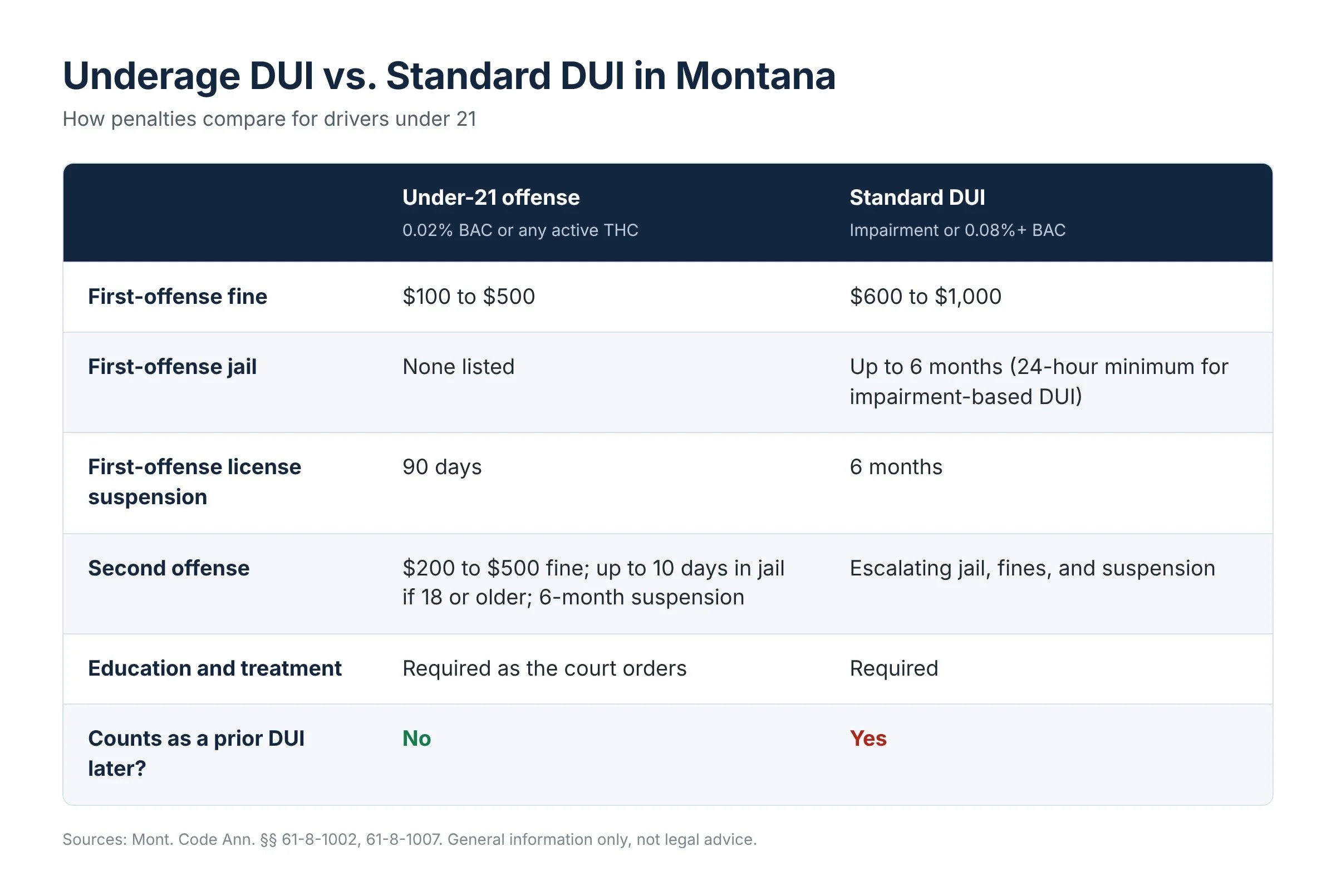
One detail in the under-21 statute is worth knowing: a conviction for the 0.02% offense can't be counted as a prior offense if you're later charged with a standard DUI. A standard DUI conviction, by contrast, follows you into any future case.
What if you refuse a breath or blood test?
Montana has an implied consent law: by driving on Montana roads, you have agreed to chemical testing if lawfully arrested for DUI. Refusing a test after arrest triggers its own administrative license suspension of six months for a first refusal. A probationary license isn't available during that suspension, and the refusal itself can be used as evidence. Refusal doesn't make the underlying case go away, and it often makes the license consequences worse.
How a DUI can affect your standing at Montana State University
Many students assume a DUI is purely a matter for the courts. At MSU, that isn't always true.
The Code of Student Conduct can reach off-campus behavior. MSU's Dean of Students Office states that, under section 610.00 of the code, the university's alcohol and drug policies apply off campus.
Sanctions are graduated. For alcohol and drug violations, MSU's recommended sanctions start with a university warning and an education course, move to conduct or residence hall probation for a second violation, and can reach conduct suspension or removal from housing for a third.
Every case is looked at in context. MSU notes that factors such as level of intoxication shape the outcome, and that court-ordered sanctions can sometimes stand in for university sanctions.
Programs and activities may have their own rules. Student athletes, students in campus jobs, and students in programs that lead to a professional license (such as nursing or education) may face separate standards or disclosure requirements. Check your program's handbook.
If you receive a notice from the Dean of Students Office, don't ignore it. The student conduct process is separate from the criminal case, and it has its own deadlines and hearing procedures.
Will a DUI affect your financial aid?
This is one of the most common worries, and the answer has two parts.
Federal aid is generally not affected by an alcohol-related DUI. The FAFSA does not ask about DUI convictions. Starting with the 2023–24 aid year, the U.S. Department of Education also removed the FAFSA's drug-conviction questions, so drug convictions no longer affect eligibility for federal student aid either.
Other aid can be affected, often indirectly:
Scholarships with conduct terms. Some institutional, private, and athletic scholarships require students to stay in good standing or follow a code of conduct. Read the terms of each award you hold.
Enrollment interruptions. If a conduct sanction suspends you from MSU, aid tied to enrollment stops while you're not enrolled.
Academic progress. Court dates, required classes, and the stress of a case can pull your grades down. Federal and institutional aid both depend on Satisfactory Academic Progress, so falling behind can put aid at risk even when the DUI itself doesn't.
If you're unsure, MSU's Office of Financial Aid Services can tell you how a conduct sanction or a drop in credits would affect your specific aid package.
Other consequences students often overlook
Car insurance. A DUI on your record can raise premiums sharply, on your own policy or your parents'.
An out-of-state driver's license. Many MSU students are licensed in another state. A Montana conviction can be reported to your home state, which may take its own action. Check with your home state's licensing agency.
Jobs, internships, and graduate school. Applications and background checks often ask about criminal convictions.
Travel. Some countries, including Canada, can deny entry to people with impaired-driving convictions, which can complicate study abroad or travel plans.
What to do if you're charged
Stay calm and be respectful during the stop. You can provide your license, registration, and insurance without discussing where you were or what you drank.
Write down what you remember as soon as you can: times, locations, what the officer said, and any tests you were given.
Watch your deadlines. License suspensions and court dates move quickly, and some rights to challenge a suspension are time-limited.
Talk to a DUI attorney before your first court date. An attorney can explain your options in both the criminal case and any related license action.
Respond to any MSU conduct notice. Ask whether you can bring an advisor, and understand the timeline before your meeting.
Stay off social media about the arrest or the case.
Talk to a Bozeman DUI attorney
An underage DUI charge is stressful, especially when you're also trying to keep up with classes and protect your place at MSU. Every case is different, and the right next step depends on the facts of yours. McKenzie Law, PLLC helps students and young drivers in Bozeman and Gallatin County understand their options. Call (406) 577-4131 or click here to schedule a confidential consultation.
This article is general information about Montana law, not legal advice. Reading it does not create an attorney-client relationship. Laws change, so speak with a licensed Montana attorney about your situation.
